Compliance & Traceability by DesignProgramme-Scale Supply & RolloutsUK Engineering That Improves ThroughputLifecycle Support & Matched Spares

Industries Served

Oil & Gas

Oil and gas operations handle heavy, high-value and hazardous items where safe storage and lifting are non-negotiable. Lowe manufactures gas bottle cages, cylinder handlers, IBC frames and certified lifting stillages engineered and load-tested for the job, on and offshore.

All UK-manufactured and UKCA-certified, with certified LOLER-rated lifting points on the ranges built for crane handling.

How Lowe helps

  • Gas bottle cages and cylinder handlers for safe, compliant storage
  • Certified lifting stillages with LOLER-rated points for crane work
  • IBC frames for the secure handling of fluids and materials
  • Bespoke, heavy-duty containment for demanding environments

Made to order

Discuss your oil & gas application

Tell us what you handle and how it moves — we'll scope a load-tested, UK-manufactured solution and quote it, usually the same working day.

Prefer to talk? 01889 563 244

Your details

Protected by reCAPTCHA · Privacy · Terms

Corrosion is the design driver.

Salt, weather and washdown decide how long equipment lasts offshore and in coastal yards, so the finish is part of the structural specification rather than a cosmetic decision at the end. Galvanised and marine-grade powder-coated finishes are specified against the exposure the unit will see and the service life expected of it.

Detailing matters as much as coating. Sections that trap water, joints that cannot be inspected and pockets that hold salt will shorten the life of a unit whatever it is painted with. Designs are drawn to drain and to be inspected, so the coating gets a fair chance of lasting.

The same reasoning applies onshore. Refinery yards, shutdown compounds and long transport routes are hard on equipment specified for a warehouse, and a unit that corrodes early is a unit that has to be re-inspected, repaired or scrapped ahead of schedule.

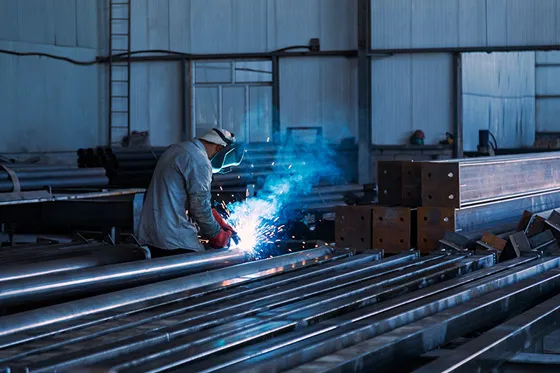
Sparks from a welding torch on steel
Steel fabrication

Pipe, tooling and heavy plant.

Pipe stillages are built to custom lengths with secure cradles that hold tubulars and line pipe without point-loading them or letting them roll. Drill support racks are engineered for transport and staging of heavy drill assemblies, where stability under partial load matters as much as headline capacity.

Tooling storage cages are lockable and stackable, which keeps high-value hand tools and equipment accounted for and off the deck. Gas bottle cages, cylinder handlers and IBC frames cover the consumables side of the same operation, where safe storage of pressurised and hazardous contents is the requirement.

All of it is engineered for high load capacity — heavy pipework, drill assemblies and robust tooling — with the structure sized against the actual load case rather than a nominal figure carried over from a catalogue.

Measuring a fabricated steel assembly
Checked against the drawing

Certified where it is lifted, documented throughout.

Heavy-duty lifting frames intended for crane lifting and offshore transfer are engineered as lifting equipment: rated lifting points, load testing and certification under LOLER, supplied with the test records. Units designed for fork handling are work equipment under PUWER and are marked for that use — the distinction is made at design stage, not on site.

Validation covers load testing, dye penetrant testing, non-destructive examination of welds and inspection reporting against a defined test plan, with finite element analysis used to prove the design where the load case warrants it.

Documentation extends to material certificates, weld procedures, inspection reports and test plans, traceable to the welder and the material batch. Identification is marked as standard — serial number, purchase order reference, TARE weight and working load limit — and units are UKCA marked where applicable. Manufacture is in Uttoxeter, Staffordshire.

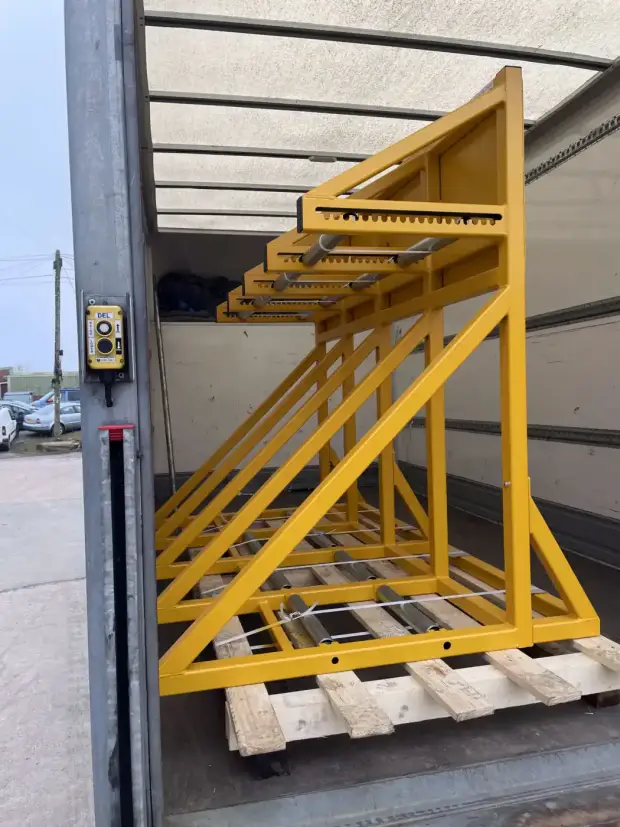
An A-frame stillage loaded into a delivery vehicle
Delivered and installed by our own team

Recommended ranges

Built for oil & gas

Browse the full range →

Our capability

Built to your drawing, not a catalogue

Send a drawing, a sample or a photograph of the part. Our engineers size the unit around what it carries and how it is handled, then build it in Staffordshire to a specification you sign off before a single length of steel is cut.

Load-tested · UK-manufactured · certified where required

Talk to an engineer →

Why Lowe

Bespoke to your process

Designed and manufactured around your components, handling equipment and floor layout — made to order or fully bespoke.

Load-rated & stackable

Engineered and load-tested for safe stacking, forklift handling and demanding industrial duty cycles.

Certifiable quality

UK-manufactured to recognised standards, with certification available on custom builds and repeatable weld and build quality.

Fast UK lead times

Manufactured in Uttoxeter, Staffordshire — short lead times and a direct line to the people building your kit.

Questions

Oil & Gas — frequently asked

What finish should we specify for offshore use?

Galvanising or a marine-grade powder-coated finish, chosen against the exposure and the service life you need. Tell us whether the unit lives on deck, in a coastal yard or inside, and whether it is washed down, because that changes both the coating and the way the structure is detailed.

Are lifting frames certified for offshore transfer?

Heavy-duty lifting frames are engineered as lifting equipment with rated lifting points, load tested and supplied with certification and test records under LOLER. If a specific offshore container or transport standard applies to your operation, raise it at enquiry stage so it forms part of the design basis from the outset rather than being retro-fitted.

Can you build pipe stillages to our tubular sizes?

Yes. Frames are made to custom lengths with cradles profiled to the pipe. Supply outside diameter, length, weight per length and how many you need to stack, and the frame is engineered around those figures rather than adapted from a standard footprint.

What testing and documentation is included?

Load testing, dye penetrant testing and non-destructive examination of welds where the specification calls for it, with inspection reports against a defined test plan. Documentation covers material certificates, weld procedures and inspection reports, traceable to the welder and the material batch.

What identification is marked on the unit?

Serial number, purchase order reference, TARE weight, working load limit and drawing reference as standard. UKCA marking is applied where applicable.

Other industries